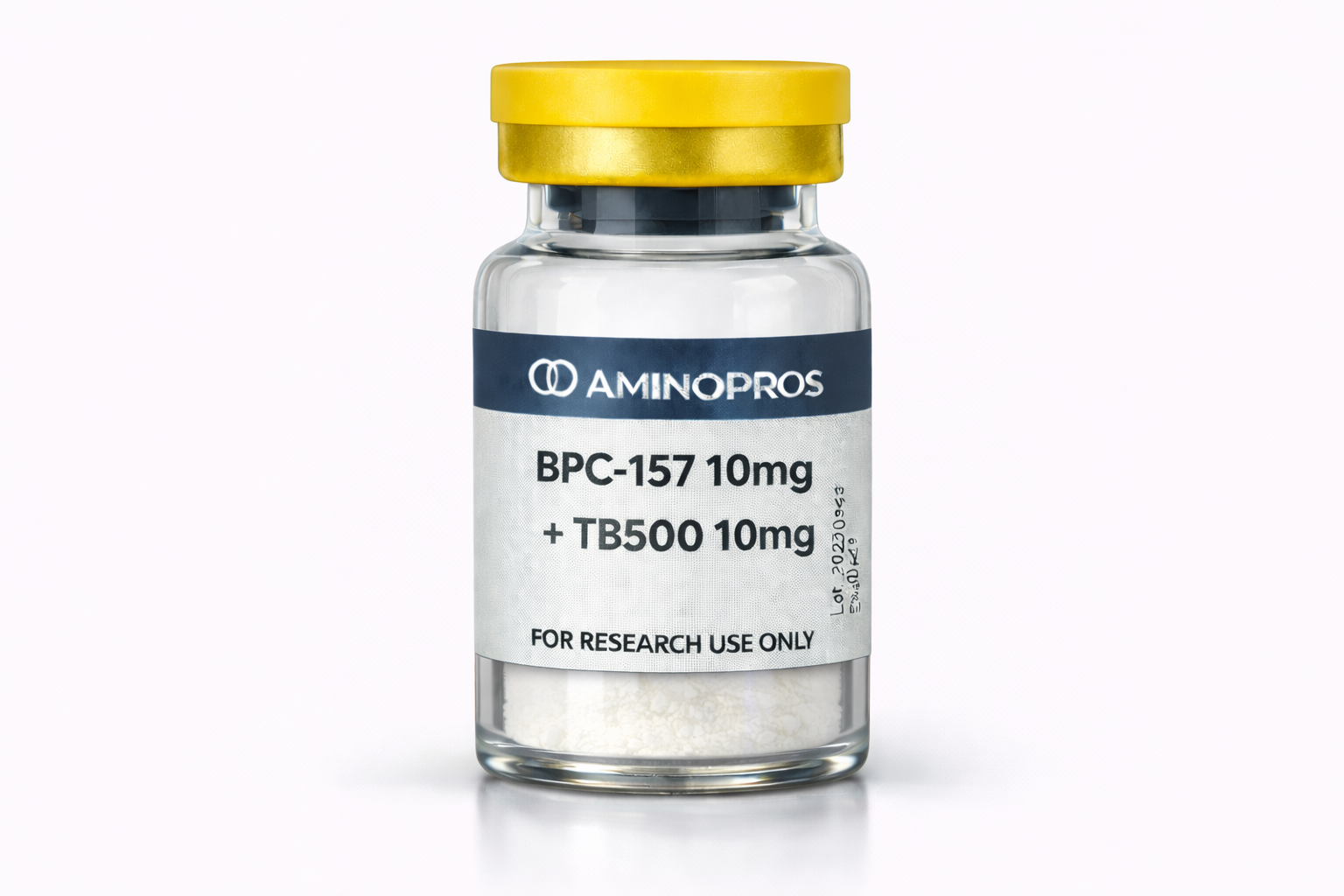
BPC157 10mg TB500 10mg
0Researcher Reviews
Rated 5 out of 5
$85.00
Third-Party Verified Test Report
This product has been independently analyzed for identity and purity.
BPC-157 + TB-500 (10mg + 10mg) is a dual-peptide research blend designed for laboratory studies involving tissue signaling, angiogenesis, cellular migration, and structured recovery pathways under controlled experimental conditions.
For Research Use Only
BPC-157 + TB-500 (10mg + 10mg)
Lyophilized peptide blend • Not for human or veterinary use
BPC-157 + TB-500 (10mg + 10mg) is a combined peptide formulation studied in laboratory environments for its potential role in tissue repair signaling, cellular migration pathways, and angiogenesis-related mechanisms. This dual-peptide system brings together two extensively researched compounds that are often evaluated for their complementary behavior within structured biological models.
In controlled research settings, BPC-157 is frequently investigated for its involvement in fibroblast activity, nitric oxide signaling, and vascular response systems, while TB-500 (Thymosin Beta-4 fragment) is studied for its influence on actin regulation, cellular mobility, and tissue remodeling environments. Together, these peptides are examined for their potential synergistic effects across multiple cellular pathways.
The lyophilized blend format of BPC-157 + TB-500 (10mg + 10mg) supports long-term stability, consistent laboratory handling, and reproducible preparation across experimental protocols. This allows researchers to maintain standardized conditions when evaluating peptide interactions in structured environments.
Research interest in this peptide combination continues to expand into areas involving connective tissue response, musculoskeletal signaling models, and cellular regeneration frameworks. These controlled models are used to better understand how peptides may influence recovery-related pathways under defined laboratory variables.
Key Research Points
- Dual-peptide blend studied for tissue repair and regeneration models
- BPC-157 evaluated for angiogenesis and fibroblast signaling activity
- TB-500 studied for actin regulation and cellular migration pathways
- Explored for synergistic effects in recovery-focused research environments
- Lyophilized format supports consistent and repeatable laboratory use
Research Applications
BPC-157 + TB-500 (10mg + 10mg) is utilized in laboratory environments focused on tissue signaling systems, cellular repair mechanisms, and vascular pathway research. These areas allow researchers to evaluate how peptide combinations interact within structured biological systems under controlled experimental conditions.
This blend is also examined in studies involving muscle recovery models, connective tissue response, and multi-pathway cellular interaction systems. The combination of both peptides allows for broader investigation into how different signaling pathways may work together within a single experimental framework.
Researchers frequently include BPC-157 + TB-500 (10mg + 10mg) in structured protocols analyzing wound-healing models, cell migration behavior, and tissue remodeling pathways, where reproducibility and controlled observation are critical.
Extended Research Notes
BPC-157 + TB-500 (10mg + 10mg) continues to be evaluated in laboratory environments for its potential role in multi-layer biological response systems, angiogenic signaling, and cellular adaptation pathways. These areas of research are essential for understanding how peptide combinations behave within complex experimental models.
The combination of these peptides allows researchers to explore compound interaction dynamics, response
Additional laboratory studies involving BPC-157 + TB-500 (10mg + 10mg) continue to evaluate compound interaction across multi-pathway signaling environments, particularly in controlled research models focused on structural response, cellular coordination, and repeatable experimental consistency.
variability, and coordinated signaling mechanisms across multiple biological layers. This makes it particularly useful in advanced research protocols requiring a broader scope of analysis.
In addition, the structured formulation supports integration into longer-term studies focused on cellular efficiency, protein signaling pathways, and system-wide biological responses. This contributes to consistent data collection across extended experimental timelines.
The standardized vial format ensures accurate measurement, ease of handling, and reliable preparation, making BPC-157 + TB-500 (10mg + 10mg) suitable for laboratory workflows centered on precision, repeatability, and controlled testing environments.
Form
Lyophilized Powder Blend
Content
BPC-157 (10mg) + TB-500 (10mg)
Appearance
White to off-white lyophilized powder
Storage
Refrigerate 2–8°C or store below 25°C dry
Explore more research compounds in our peptide research collection.
For additional research background, review published literature on PubMed.
Disclaimer: For laboratory research use only. Not approved for human or veterinary use, ingestion, or medical applications.
Reconstitute using sterile technique under controlled laboratory conditions.
Reconstitute using sterile technique under controlled laboratory conditions.